Why you want more disagreement in the workplace
Insights from the closing keynote of Ragan’s Employee Communications and Culture Conference.
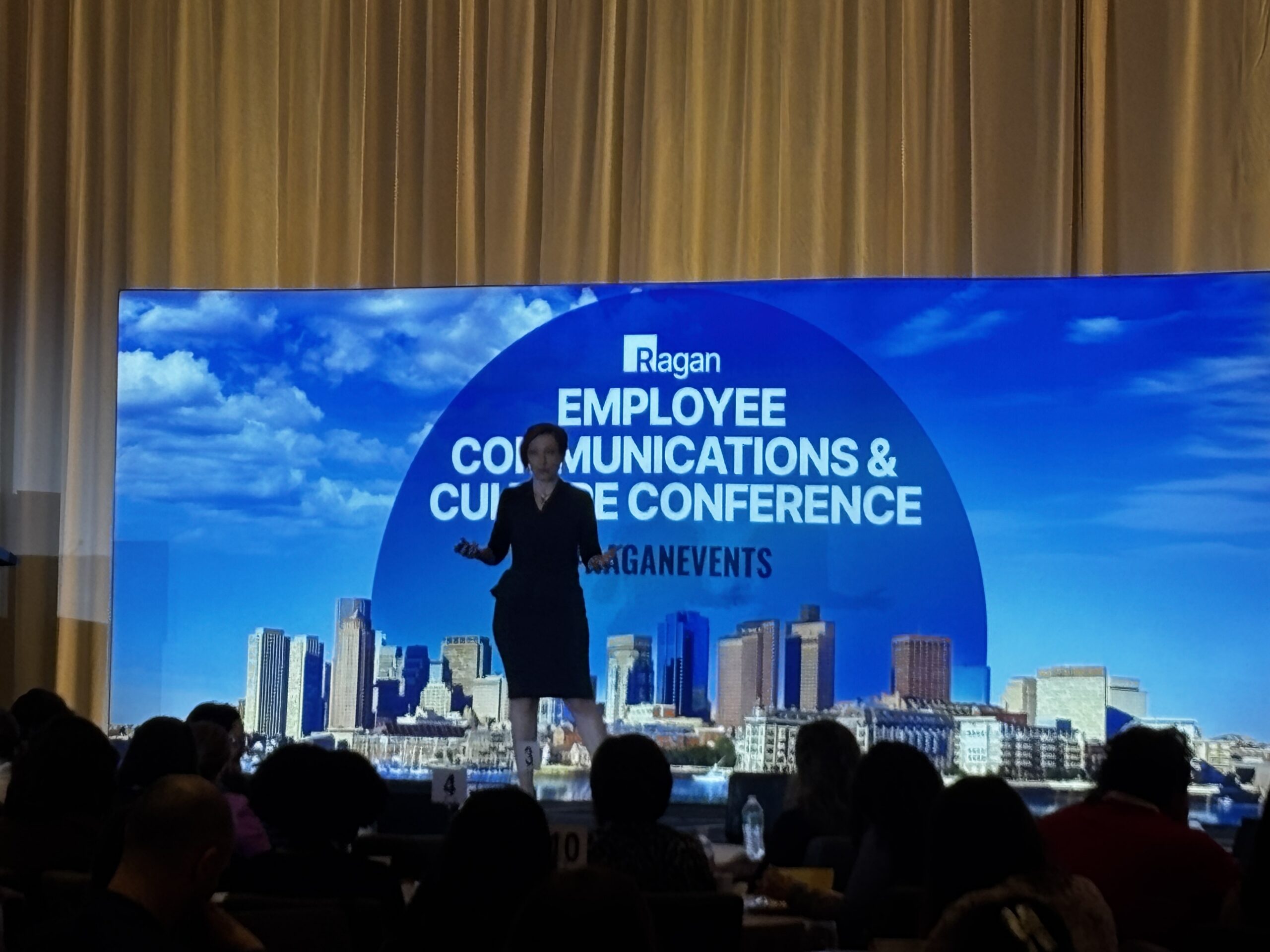
A big part of an internal communicator’s job is embracing and encouraging two-way dialogue. But what’s not talked about as much is how to handle disagreements.
During her keynote address at Ragan’s Employee Communications and Culture Conference in Boston, Julia Minson, professor of public policy at the Harvard Kennedy School of Government, told the audience that the line between disagreement and conflict is thinner than most people realize.
“When we think about disagreement, what we’re actually talking about is a difference in beliefs, preferences or expertise,” she said. “Conflict starts when we have the type of disagreement that I can no longer allow you to continue believing whatever it is you believe. I’m going to correct you, or educate you, or improve you, and that combination often results in mounting frustration.”
Minson added that the instinct to resolve any disagreement immediately can be misplaced, stating that not every productive on-the-job conversation requires complete alignment.
“After you do that initial engagement, you are totally free to say, ‘Look, I get you, and I still disagree,’” she said. “I understand why a smart, reasonable, moral person could hold your beliefs, but they are not my beliefs.”
As people who touch diverse functions with varying viewpoints within a company, internal communicators know that success comes from understanding others, not total consensus.
“When people give a lot of consideration to folks who have different perspectives, organizations learn better and we’re better at predicting the future,” Minson said.
The language that shapes better conversations
Even when both sides know that their arguments are productive in the long term, their language and behavior during a disagreement are what often form the overall outcome.
“In conflict, you get far more credit for observable behavior than for thoughts,” she said. “Most of the time when we train people to be better at navigating conflict, we talk about empathy, perspective-taking and listening. But listening is an internal process that happens between your ears. The question is: what are the observable behaviors that actually shift the trajectory of a conversation?”
Internal comms pros know this dynamic well. They’re ultimately judged on how a message is received, not the intent they had while drafting it. Minson floated the idea of conversational receptiveness to try to bridge gaps in understanding when disagreements arise.
“Conversational receptiveness is words and phrases that make the other person feel heard in disagreement,” she said. “It’s taking what’s happening in your head and translating it into a clear signal that other people can interpret.”
Minson also shared her HEAR framework for clearing up communication during disagreements. The acronym stands for:
- Hedge
- Add nuance to the conversation and avoid absolutes
- Emphasize agreement
- Find common ground when possible
- Acknowledge
- Show you’re listening to the other person or people involved in the discussion
- Reframe positively
- Avoid negative language when discussing the other party’s position
Minson said running through this framework when disagreements arise can establish alignment with the fact that all parties want the organization to succeed, but might have different paths in their heads about how to get there.
“It’s about taking a few seconds to put us on the same side of the table before we dive into dissecting the disagreement,” she told the audience. “People mimic the conversational style that somebody else introduces. It gives you tremendous control over your conversations.”
For internal communicators, that sort of control is necessary when you’re creating messaging that creates workplace culture.
“Our goal should be more disagreement, less conflict,” Minson said.
Sean Devlin is an editor at Ragan Communications.