Vibe coding: An introduction for comms pros
What it is and how it can help save time.


If you’ve seen the phrase “vibe coding” floating around your LinkedIn feed lately, you’re not alone. It may sound a bit daunting at first if you don’t have any coding experience. But the idea behind it is changing how people build tools for their day-to-day work.
Alex Mahadevan, director at MediaWise, the nonprofit initiative of The Poynter Institute, explained how he’s been experimenting with these tools.
“If you have a problem you’re trying to solve and you think you can solve it with technology, vibe coding might get you there,” he said.
What vibe coding actually means
Vibe coding is shorthand for using agentic AI coding tools to build software by describing what you want in plain language. In other words, you’re explaining the “vibe” of something you want to achieve and an LLM creates it for you.
“Generally what it means is using an agentic AI coding tool to create an app or a web page or something from scratch, sort of based on vibes,” Mahadevan said. “You have an idea in your head, and you send an AI agent to use tools to build it.”
Instead of writing code line by line, you tell an AI agent what you’re trying to make through a set of very specific set of instructions, he said. This could be a Slack bot, a simple website, an app or a monitoring tool, and the system goes off and builds it. You provide the color scheme, function and how you want it to look.
The LLM will take actions to create files, pull data, test outputs and then come back with questions when it needs clarity.
“Do you want this Slack bot to DM people? Do you want it tagged in a channel? It helps clarify the task,” he said.
The clearer your instructions, the better the output, he said.
Read more about how to get started on our Communications Leadership Council site here.
Who’s using it
Right now, vibe coding is most common among people who aren’t traditional developers but are comfortable experimenting with AI tools. This includes journalists, educators, analysts and PR pros.
Mahadevan said at Poynter, he vibe coded a custom Slack bot for a reporter who covers press freedom. Her job required monitoring dozens of Google Alerts and RSS feeds every day – not unlike the media monitoring PR professionals do. He built a tool using specific instructions that would do this for her.
“It took me less than two hours to build,” he said. “It cost maybe two dollars and it’ll probably cost about a dollar a month to maintain.”
Mahadevan primarily uses Claude Code, but ChatGPT and others now offer agentic features.
Examples PR pros can relate to
Mahadevan has used vibe coding for a variety of other tasks in his newsroom that PR teams could mirror. Here’s a breakdown based on :
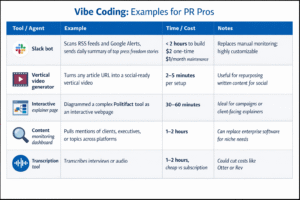
“These are small, focused tools you can build from,” Mahadevan said.
Why PR people should care
One its biggest benefits is that vibe coding opens the door to creating custom tools without waiting on IT or paying third parties for SaaS, Mahadevan said.
Think about tasks you’re already doing, whether that’s:
- Tracking brand mentions
- Turning written content into social or video formats
- Building campaign microsites or interactive explainers
- Consolidating internal reporting dashboards
It’s not about replacing enterprise platforms overnight or abandoning them, he said. Vibe coding can help fill gaps on a fixed budget, especially for internal or niche needs, he said.
Risks
When testing out vibe coding, especially in this early phase, don’t overlook or underestimate associated risks, Mahadevan said. Security data handling and ethics should always be top of mind during the process.
“If I create a public AI tool and I’m just vibe coding my way through it, I might expose that API to the public,” he said.
This is why it’s critical to loop in someone with technical experience before sharing anything publicly. Treat early experiments as prototypes, Mahadevan said.
“Build, test and iterate constantly” before launching anything publicly, he said.
Outlook
The biggest benefit of vibe coding is that it gives teams the ability to build solutions quickly, cheaply and independently, Mahadevan said.
Even skeptical teams should be watching this space right now, he said. The ability to build your own tools quickly changes the game, he said.
“Vibe coding is really giving communicators, and many industries, the ability to create solutions instead of just asking for them,” he said.
Courtney Blackann is a communications reporter. Connect with her on LinkedIn or email her at [email protected].