How Cinnabon built a social fandom by ‘marrying’ Slim Jim
Insights from behind the social handle.

Not every social media campaign requires a planned strategy.
If you were on X during the height of brand banter a few years ago, you may remember an unlikely relationship unfolding in real time: Cinnabon and Slim Jim flirting, escalating and eventually “getting married” on the internet.
Hannah Gregus, social media manager for Cinnabon and Carvel, explained how it happened and why it worked. She will share her insights this month during Ragan’s Social Media Conference.
“It truly started with just noticing how much engagement Slim Jim was getting,” she said. “We weren’t trying to pitch them anything. We just started engaging.”
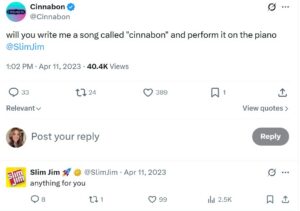
There was no campaign plan behind the first exchange, she said. They weren’t working together behind the scenes and Gregus didn’t reach out with her plans.
At the time, Cinnabon was intentionally trying to increase the volume of its replies and engagement on social. It was around National Boyfriend/Girlfriend Day when the interactions began, she said.
Gregus’ colleague “asked if we could do something…and we just started interacting with them like we had a crush on them,” she said.
Slim Jim responded. The back-and-forth continued. Fans began noticing and interacting too.
“We were leaning into internet culture and community engagement,” she said. “Our end goal was building a fandom.”
While the two brands were very different, with Gregus explaining that Cinnabon is traditionally more “brand safe” while Slim Jim is “way more counterculture,” the back-and-forth worked because it felt real.
“It was successful because it wasn’t forced,” she said.
Brands that lean into cultural moments naturally can create lasting impact, she said. Take notice of what people are discussing and how they’re discussing it. Is there a way to interact naturally that draws others into the conversation?
In this case, people wanted to see how far the flirtation would go.
Building the relationship
The “relationship” lasted for about a year before it became a formal collaboration.
“That naturally built a fandom around it,” Gregus said. “People started expecting it.”
By the time Slim Jim suggested turning the interaction into something bigger, the audience already understood the joke and felt like they were in on it. People want to feel included and part of something, Gregus said. There was no need to explain why the brands were interacting or why it mattered, she said.
Even other brands began amplifying the relationship.
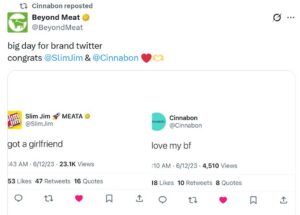
The story had build-up, excitement and it was open-ended, Gregus said. Sometimes brand collaborations fail because they feel too fully formed without giving audiences time to care, she said. By sharing only a little bit at a time, people relished in the journey.
“People kept coming back because they were waiting to see what happened next,” Gregus said.
When it turned into a campaign
Eventually, Slim Jim reached out with an idea.
“They were like, ‘We want the internet to be able to watch these two brands get married,’” Gregus said.
The execution stayed native to where the story had already been living:
- Vows exchanged on X
- Bachelor- and bachelorette-style content and audience polls
- Wedding mailers and novelty merch
- A hybrid Cinnabon–Slim Jim recipe
The teams focused on symbolic moments and storytelling rather than pushing products, she said.
“People were dying to see how this wedding would play out,” Gregus said. “It became just as much about their input and reactions as the wedding itself.”
What success looked like
There were no hard KPIs tied to the effort, Gregus said.
“We didn’t have goals like X impressions or X engagements,” she said. “Our goal was honestly to break the internet a little bit.”
The bigger objective was perception.
“Cinnabon had historically been associated with nostalgia,” she said. “We wanted people to see that we’re present and active in internet culture.”
The momentum carried well after the “wedding” was over.
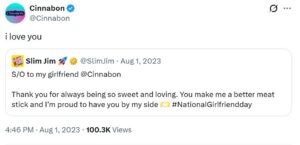
“We’d still get comments six months later like, ‘Has Cinnabon asked you to be their Valentine yet?’” Gregus said.
At that point, the audience was fully invested.
Why this matters now
With shrinking budgets and fewer guaranteed media hits, social teams are increasingly responsible for generating relevance before PR ever pitches a story.
“You have to give people a reason to talk about it,” Gregus said. “And that usually starts with what consumers care about.”
The Cinnabon–Slim Jim moment worked because it wasn’t designed to work like a campaign, she said. It was allowed to exist, grow and only later become something bigger.
Register here to learn more from Gregus and other industry experts during Social Media Conference March 9-11 in Orlando, Florida.
Courtney Blackann is a communications reporter. Connect with her on LinkedIn or email her at [email protected].