Good news for communications practitioners even amid AI boom, HarrisX-Ragan CEO survey finds
Trust is swinging back to people over machines.


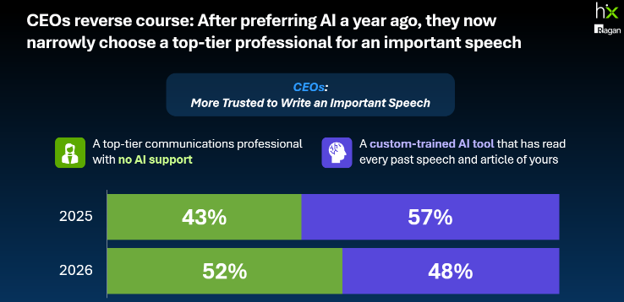
Last year, a HarrisX-Ragan survey finding startled the comms world: 57% of CEOs would rather have their speeches written by an AI trained on all their past speeches rather than an experienced human communicator.
It was a frightening, even existential finding that seemed to show that leaders prioritized the precision and breadth of knowledge from an AI over the experience and humanity of a person.
This year, the 6th annual edition of the HarrisX & Ragan Survey of CEOs and Communications Leaders found that as the promise and limitations of AI come into focus, leaders are beginning to appreciate human communicators once more.
This year, 52% said they’d rather have the human communicator, a shift of 9 points year over year. A slim majority to be sure, but it’s one of several findings from the study that shows AI is no longer seen as a cure-all for the important work of communications.
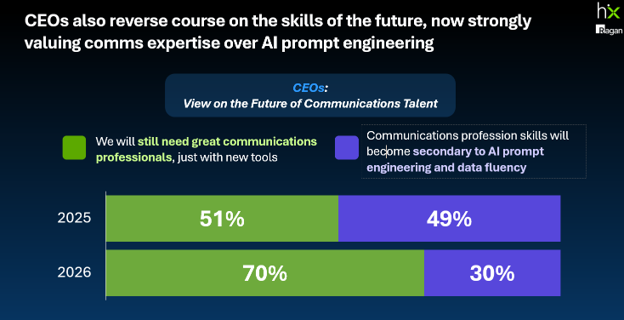
Perhaps a more illuminating statistic found that 70% of CEOs said that in the future, they see communicators armed with AI tools as vital to a company’s success, versus 30% who said AI prompting and data fluency were the most important skills for a communicator. That’s a major reversal from last year, with an increase of 19 percentage points for those who believe in importance of communications skills over AI supremacy.
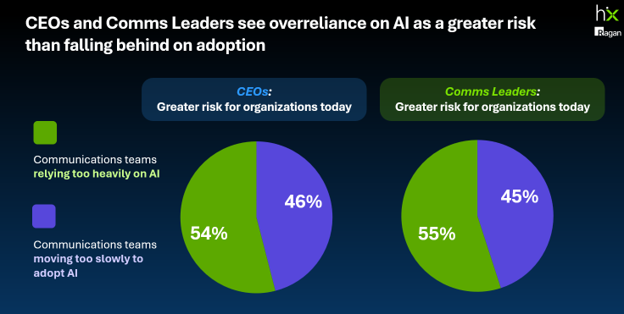
Indeed, communicators and CEOs are in agreement that the greatest danger right now is not that the comms field will fall behind in their AI skills. Rather, it’s that these departments become too reliant on AI, abdicating judgment and humanity to the machine.
Why it matters
In just a year, we’ve seen a major shift in CEO opinion on AI use in communications. While the survey did not probe the exact why behind these questions, we can make some inferences.
The world has become more familiar with AI — its possibilities and its limitations. They’ve seen that it can put out polished copy, but that it’s strangely empty and non-specific.
It’s worth noting that the speechwriting statistic that raised so many eyebrows last year forces a binary response: Only AI or only a person. The more nuanced answers show that the majority of leaders see the way forward as a combination of the best of AI and the best of people — though with human skills seen as the more important of the two.
As “AI slop” becomes a part of everyday language, used to describe everything from email copy to images on a menu, the risks of the homogenous, bland language and imagery created by AI are becoming easier to spot. CEOs see the risks in messaging that only skims the surface and risks becoming pretty, polished background noise. That’s why the increased concern in over-reliance on AI is growing, combined with concerns about outsourcing higher-level thinking to artificial intelligence.
AI can never create something truly new. AI can never care about another person. AI can never understand the inside jokes of an organization.
This year’s survey shows a maturation of the AI adoption process. It’s no longer a magic bullet, but a tool like any other. We see this also in the top uses cases of AI among communicators. There is a decided shift away from using these tools for things like writing and crisis communications and into tasks like research, brainstorming and copy editing.
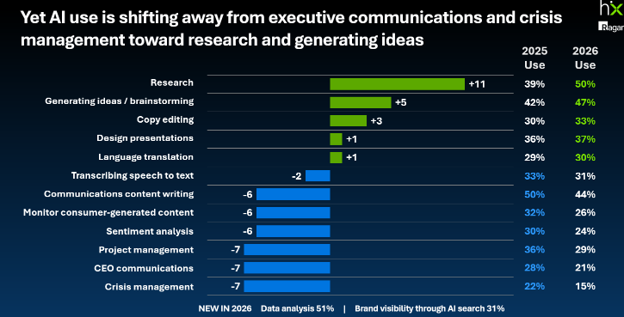
Roles where higher-level strategic thinking and empathy are required are increasingly being put back into the hands of humans.
Of course, AI will keep evolving. But at the moment, the balance between machine and human in communications is tipping back toward people.
For more insight, including information on how CEOs think about social issues, the changing role of social media in crisis management and more, download the full report.
Allison Carter is editorial director of PR Daily and Ragan.com. Follow her on LinkedIn.