What makes for a great brand partnership
A Macy’s Thanksgiving Day Parade collab shows the power of the unexpected.

Putting two recognizable names together doesn’t automatically make a strong brand partnership.
Collaborations are more effective when communicators recognize what one organization can do for the other that it can’t credibly do on its own.
This is the idea behind a new campaign between Macy’s and Khan Academy ahead of its 100th Macy’s Thanksgiving Day Parade.
“When we met with Khan Academy, it felt like a natural partnership from the start,” said Christine Olver Nealon, director of external communications at Macy’s. “Macy’s brings the creativity, cultural relevance and excitement of the parade, while Khan Academy brings the educational expertise and the ability to make learning engaging and accessible.”
The partnership works because Macy’s has cultural recognition while Khan Academy has the educational expertise and established relationships with teachers and students.
For comms teams, it’s important to evaluate with what your organization is missing and where a collaboration can fill a gap or help you reach a new audience authentically.
Find the credibility gap
The company could have relied heavily on nostalgia, which can be useful. Instead, they decided to look for something people got excited about and associated with the parade, but with a twist.
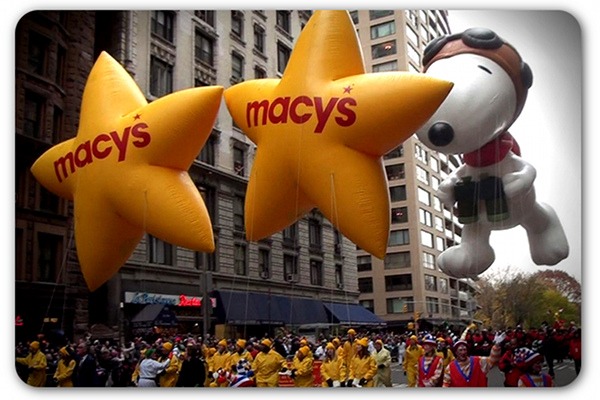
The organizations created a free educational activity that teaches elementary students about buoyancy, balanced forces and engineering through the parade’s giant balloons, which are one of its most recognizable features. It asks students, “How does a giant balloon float in mid-air without moving up or down?”
“The concept was a natural fit as our parade balloons are so recognizable that they provided an accessible way to introduce STEAM concepts to kids through a familiar lens,” Nealon said. “Rather than telling students about the science behind the balloons, the activity allows them to investigate concepts (on their own).”
Human connection and engagement were just as important when planning the activity, she said.
Before choosing a collaborator, ask:
- What audience are we trying to reach?
- What do we already have that could be valuable to them?
- Where do we lack expertise, access or credibility?
The third question should help determine the partner.
This can be useful for many industries. A tech company trying to talk about workforce development, for example, may have the data but lack connections to educators or workers, so it would be beneficial to collaborate with an organization that does.
A partner shouldn’t only expand your audience and reach, it should also strengthen the reason the audience should pay attention.
Bring comms on board well before launch
External communications helped create the idea and work through the process rather than being brought in afterward.
Her team helped drive the concept and connected its Social Impact, Macy’s Studios and marketing teams to bring it together. External comms also worked with Khan Academy as the science and engineering behind the balloons was translated into an activity, so they were able to be truly involved throughout the planning together.
That gave them an opportunity to pressure-test their partnership before launch.
Can you explain why these organizations belong together in one sentence? Does each bring a distinct strength? Is the collaboration useful to the audience, or mostly useful to the brands? These are things we established before creation.
If those answers had been difficult, the partnership itself may have needed some more work.
Think about access over reach
Khan Academy also gave Macy’s a direct route to the audience it wants. The organizations planned social and newsletter support, and Khan Academy can extend the activity through its network of educators.
A partner with millions of followers may generate impressions and a spike in engagement. But a partner with established relationships inside the exact community an organization wants to reach can offer access with context.
The same thinking applies beyond education. A community organization, trade association, nonprofit, creator or niche media outlet may be more strategically useful than a much larger partner if it already has trust with the right people.
For Macy’s, this also gives its anniversary story somewhere new to go.
“For launch, we looked at this as part of the larger storytelling around the 100th Macy’s Thanksgiving Day Parade,” she said, “We used the milestone to show how the parade can spark learning and stay relevant for students, families and fans across the country.”